
Most new online business owners ask the same question eventually: What do I actually need to know to succeed at this?
They expect the answer to involve SEO secrets, the perfect social media posting schedule, or the magic product-research tool that unlocks six figures. What they rarely expect is an answer that starts with time management and patience. Yet those are exactly the kinds of foundational skills that separate the people who stick it out from the ones who burn out six months in.
The following five skills won’t get as many clicks as “10 Shopify Hacks,” but they will do something more important: they’ll make everything else you’re learning actually stick.
- Time Management — And Not the Complicated Kind
Time management gets overcomplicated fast. The moment someone says “time management,” half the room imagines color-coded productivity systems and 5 a.m. routines. That’s not what this is.
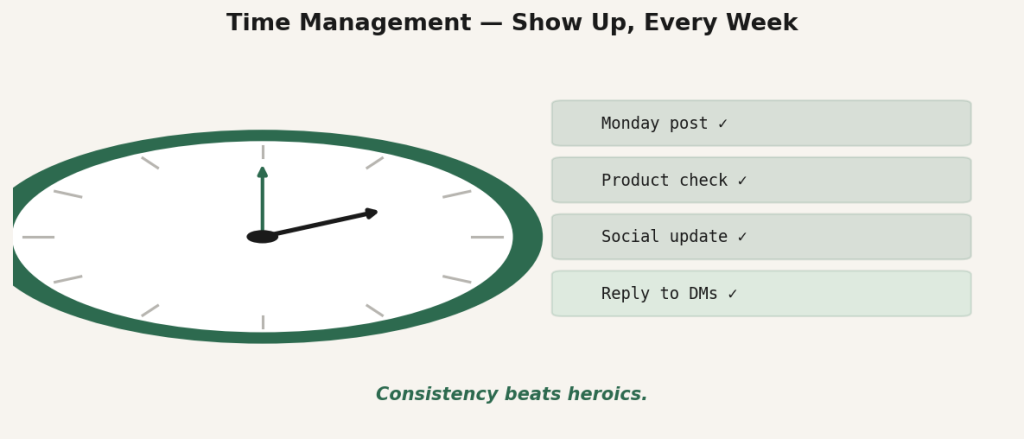
Running an online business requires consistency more than it requires heroics. Content needs to go out. Products need to be checked. Social media doesn’t post itself. None of these tasks are individually overwhelming — but they quietly pile up when you don’t have a system for touching them regularly.
The good news: the system doesn’t have to be sophisticated. A physical whiteboard on the wall works. A paper calendar on the desk works. A phone app that sets a reminder that fires at 2 p.m. every Tuesday works. The reminder itself is doing the “time management” for you — your only job is to not swipe it away.
The real goal is to convert your recurring responsibilities into habit. Once the routine is internalized, consistency becomes automatic. Until then, use whatever external system keeps you honest — because the businesses that stay afloat are almost always the ones where the basics are getting done, week after week.
Consistency beats heroics.
- Basic Browser Skills — The Overlooked Productivity Multiplier
This one sounds almost too simple to mention. But the number of people trying to run an online business entirely from a phone, bouncing back and forth between a single tab, is staggering — and it’s quietly costing them hours.
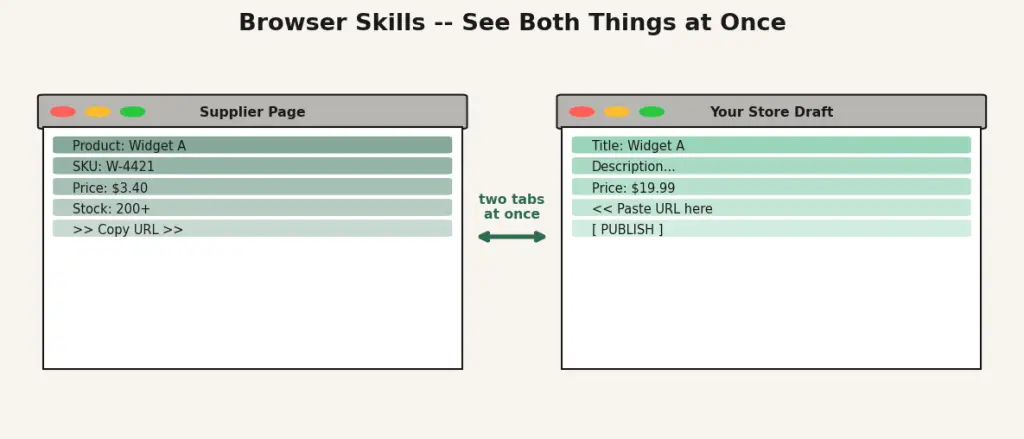
Here’s the specific behavior that slows people down the most: copying a link from one page to paste into a Facebook post on the same page, forcing them to navigate away from a half-written post to grab the URL, then navigate back, often losing their place in the process. It’s a small frustration, but repeated dozens of times a week it adds up to a genuine productivity drain.
The fix is simply learning to use your browser the way it was designed: multiple tabs open simultaneously, multiple windows arranged side by side, the ability to see what you’re referencing and what you’re creating at the same time.
On Windows, hovering over the maximize button reveals built-in snap layout options that let you divide your screen between two views with a single click. A second monitor unlocks this even further. None of this is advanced technology — it’s just using the tools that are already there.
- Patience — The Skill You Can’t Download
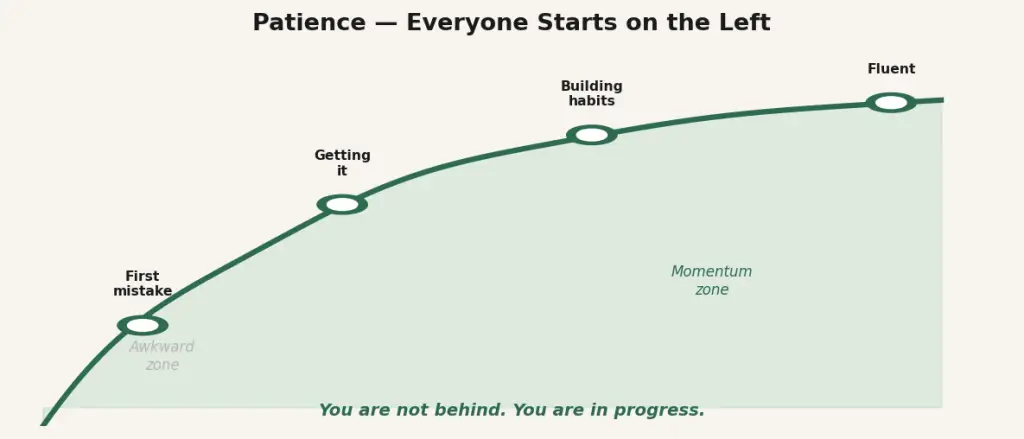
Learning any new system feels awkward before it feels natural. That’s true for importing products, writing blog posts, setting up automations, managing a social media calendar — everything. The first time you do it, you’ll probably make a mistake. The second time, fewer mistakes. By the tenth time, you won’t even have to think about it.
The problem is that a lot of new business owners treat their early mistakes as evidence that they’re not cut out for this, rather than as a normal part of the learning curve. They get frustrated, approach the next session carrying that frustration, and are predictably less able to absorb new information.
The people who learn fastest are almost always the ones who’ve given themselves permission to not be perfect yet. They hit a snag, take a breath, identify specifically where things went sideways, ask for help on that specific thing, and come back to it fresh.
You are not behind. You are in progress.
- Ask Questions — Seriously, Just Ask
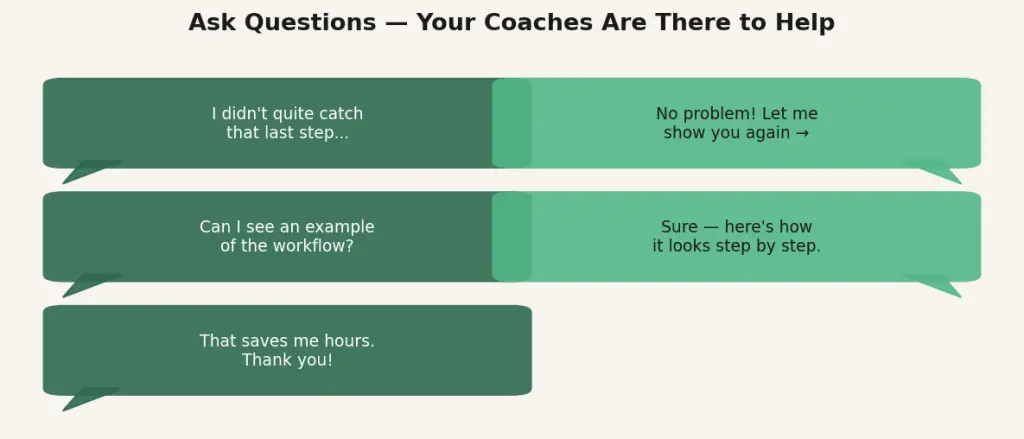
This skill sounds obvious enough that it almost doesn’t need to be said. And yet it does, because a surprising number of people working with coaches, trainers, or support teams go through entire sessions nodding along without flagging the things they genuinely didn’t understand.
Sometimes it’s shyness. Sometimes it’s the worry of seeming slow. Sometimes it’s just the habit of saying “I’m good” reflexively, even when you’re not entirely sure you’re good.
Here’s the practical reality: the question you’re holding back is almost certainly not a burden. If a concept didn’t land the first time, ask for a different explanation. The investment of a well-timed question is almost always worth more than the time it takes to ask it — it can prevent hours of confusion downstream.
Your coaches, support reps, and community members are there specifically because someone else has already figured out the thing you’re struggling with. Use that.
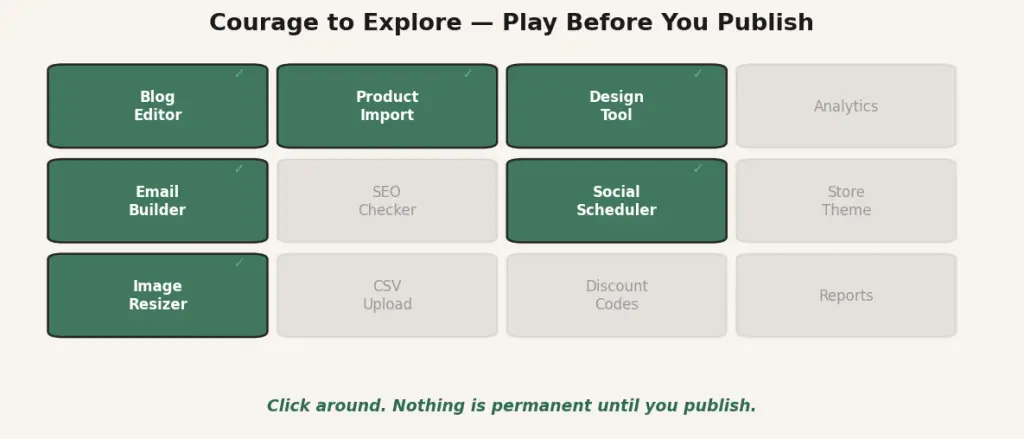
- Courage to Explore — Play Before You Publish
There is a version of caution that protects you from real mistakes, and there is a version of caution that just keeps you from getting comfortable with your own tools. New business owners frequently fall into the second category.
They have a blog editor open and they’re afraid to click the formatting buttons. They’ve signed up for a free design tool and they’re afraid to drag anything onto the canvas.
Here’s a rule of thumb that removes most of the risk: if you’re not saving, publishing, or entering payment information, you’re almost certainly safe to explore. Most tools operate on drafts and previews. Nothing is permanent until you intentionally make it permanent.
The people who build the most impressive things online are almost never the ones who knew everything before they started. They’re the ones who started and figured it out as they went, one mistake at a time.
Click around. Nothing is permanent until you publish.
The Common Thread
Notice that none of these skills are technical. They don’t require a specific piece of software or a particular level of prior experience. They’re attitudinal and behavioral — which means anyone can develop them.
What changes when you bring these skills to your online business is that the technical learning you’re doing on top of them actually has somewhere to land. Time management means you show up consistently enough to build momentum. Browser skills mean you can see what you’re working with. Patience means you stay in the game long enough to improve. Questions mean you’re getting real help instead of guessing. And the courage to explore
means you’re building real fluency with your tools instead of just watching from the edge. None of this is glamorous. But it’s what works.
Based on the Your Sight Builders Podcast — Season 4, Episode 9